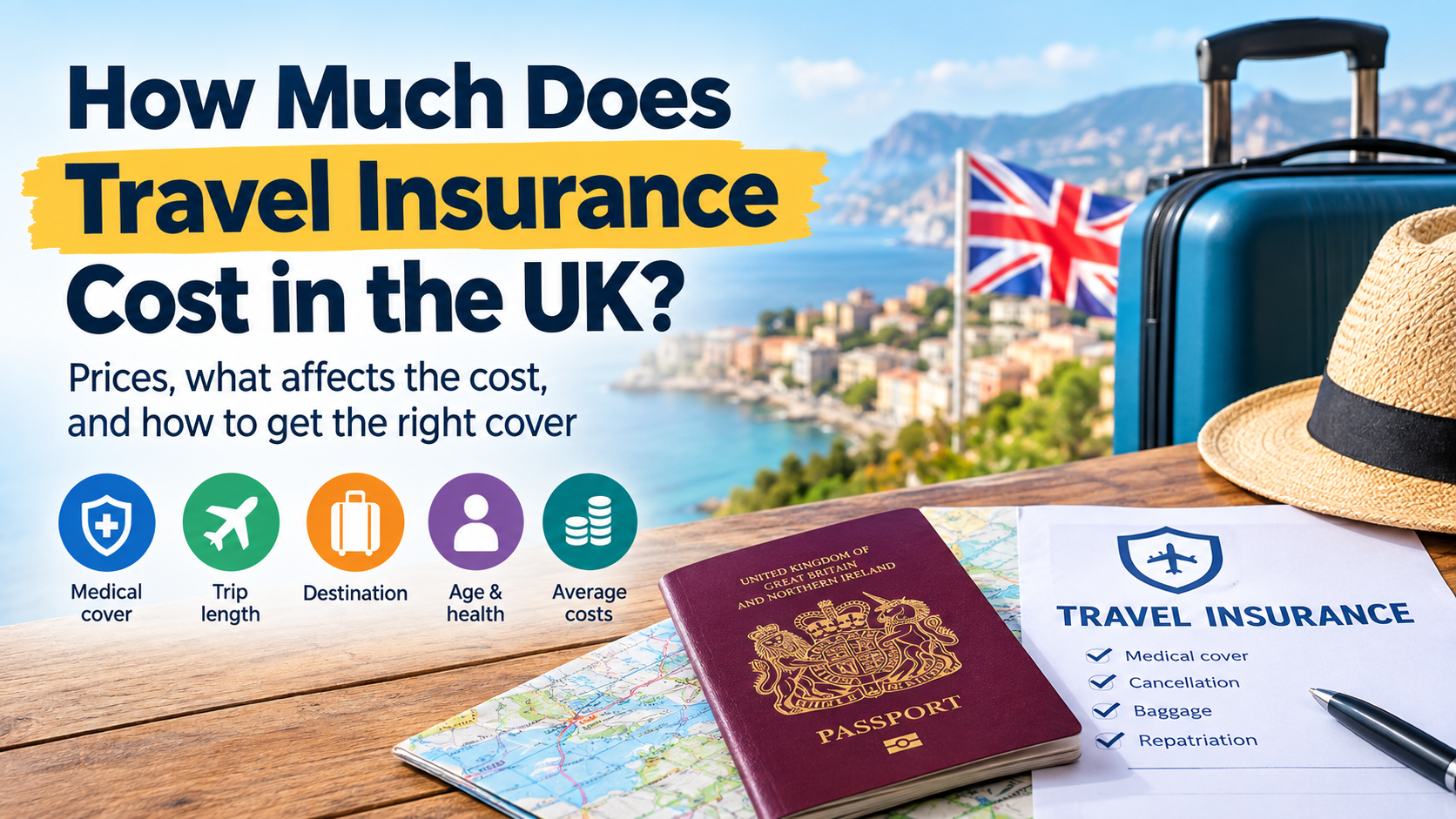
Find out how much travel insurance costs in the UK, what affects the price, what cover you need and how to find the right policy.
For most UK travellers, travel insurance can cost less than a typical airport meal. But the price varies widely depending on your age, destination, trip length, medical history and the level of cover you choose.
Current MoneySuperMarket data puts the average price of a single-trip travel insurance policy at £22.43, while annual multi-trip cover averages £52.09. Backpacker and long-stay policies are much more expensive, averaging about £207.09. These figures are useful as a guide, but your own quote may be higher or lower.
The important point is not simply to find the cheapest Travel Insurance UK policy. You need enough cover to protect you from the costs that could seriously damage your finances if something goes wrong abroad.
Quick answer: what does travel insurance cost?
For a simple European holiday, you may find cover for considerably less. A trip to the USA, Canada or another destination with high medical costs can be much more expensive.
For example, MoneySuperMarket's 2026 data shows average destination prices of around £15.82 for France, £17.44 for Spain, £12.67 for Portugal and £64.10 for the USA.
What determines the price of Travel Insurance UK policies?
There is no single standard price because insurers assess the risk of each traveller and trip.
1. Your age
Age is one of the biggest factors affecting travel insurance premiums.
Younger travellers typically pay less, while premiums tend to rise as you get older. MoneySuperMarket's recent figures show average single-trip prices ranging from about £23.71 for people aged 18–49 to £97.62 for those aged 80–84.
This does not mean older travellers cannot find affordable cover. It simply makes comparing policies more important.
2. Your destination
Where you are travelling can have a major impact on your premium.
Medical treatment can be extremely expensive in countries such as the USA. That is why worldwide cover including the USA, Canada and the Caribbean often costs more than European cover.
MoneySuperMarket's current figures illustrate the difference: average cover for the USA is about £64.10, compared with £10.40 for Germany.
Always make sure your policy covers every country you intend to visit.
3. How long you are away
A two-week holiday and a six-month backpacking trip present very different risks.
Longer trips generally cost more to insure, which is why specialist backpacker and long-stay policies can be considerably more expensive than standard single-trip cover.
If you are travelling for several months, check the policy's maximum trip duration carefully. A cheap annual policy may not cover one continuous trip for as long as you expect.
4. Pre-existing medical conditions
Your health can have a significant effect on the price of travel insurance.
You should declare relevant pre-existing medical conditions, including conditions that are being investigated or treated. The FCDO warns that failing to disclose existing conditions can invalidate your insurance.
Medical cover is particularly important because treatment abroad can be extremely expensive.
In 2024, ABI members paid £262 million in travel insurance medical claims, with medical claims accounting for 34% of all travel insurance claims. One insurer paid more than £1 million after a customer required emergency treatment and repatriation from the USA.
5. What you want the policy to cover
A basic policy may be cheaper, but it may not include everything you need.
You may pay more for cover such as:
Winter sports
1. Winter sports
2. Cruise holidays
3. Adventure activities
4. Business travel
5. Gadget insurance
6. Higher cancellation limits
7. Additional baggage protection
8. Specialist medical cover
The right choice depends on your holiday. There is little value in paying for extras you will never use, but cutting essential protection simply to save a few pounds can be a false economy.
Single-trip vs annual travel insurance
If you only take one holiday a year, single-trip insurance will often make more financial sense.
If you travel several times a year, an annual multi-trip policy could work out cheaper and saves you from arranging separate cover for every journey. Money Super Market says single-trip cover is often suitable for occasional holidays, while annual cover can be more cost-effective if you travel several times a year.
However, check the maximum number of days allowed for each trip. An annual policy does not necessarily mean you can stay abroad for the entire year.
Does the cheapest travel insurance offer enough cover?
Not always.
When comparing Travel Insurance UK policies, the premium should be only one part of your decision.
Look carefully at:
Medical expenses
This is arguably the most important section. Check the medical expenses limit and whether emergency repatriation is included.
Cancellation and curtailment
Make sure the cancellation limit is high enough to cover the non-refundable costs of your holiday.
For an expensive family holiday, a policy with a low cancellation limit could leave you substantially out of pocket.
Baggage and valuables
Check both the total baggage limit and the single-item limit. A policy may cover £2,000 of luggage but only £300 for one item.
Excess
The excess is the amount you may have to pay towards a successful claim.
A policy with a very low premium may have a relatively high excess. Always compare the two.
Exclusions
Read the exclusions before buying. Common restrictions can involve alcohol, certain sports, undeclared medical conditions and destinations where the FCDO advises against travel.
Do I need travel insurance if I have a GHIC?
Yes.
A Global Health Insurance Card (GHIC) can give eligible UK residents access to medically necessary state healthcare in the EU and certain other countries on the same basis as residents of that country.
But it is not a replacement for travel insurance.
The FCDO says GHIC and EHIC cards do not cover private healthcare, repatriation to the UK or other costs such as mountain rescue.
Think of the GHIC as useful additional protection rather than a substitute for insurance.
How to reduce the cost of travel insurance
You do not necessarily have to buy the most expensive policy. Instead, focus on getting appropriate cover at a competitive price.
Compare policies, not just prices
Get several quotes and compare the important limits, exclusions and excesses alongside the premium.
Choose the correct geographical cover
If you're visiting France, you may not need worldwide cover that includes expensive destinations such as the USA.
Consider annual cover if you travel regularly
Add up the cost of the individual policies you would otherwise buy. An annual policy may work out cheaper if you take several trips.
Buy cover soon after booking
Buying insurance shortly before departure can leave you without cancellation protection for the period between booking and travelling.
The FCDO recommends taking out appropriate travel insurance before travelling, while MoneySuperMarket recommends arranging cover as soon as you book your first holiday so cancellation protection can start.
When is travel insurance worth paying for?
For a short, inexpensive holiday, you might wonder whether insurance is worth the cost.
The answer becomes clearer when you consider the potential size of a claim.
The ABI says its members dealt with more than 500,000 travel insurance claims worth £472 million in 2024. Medical emergencies were the most common type of claim.
The FCDO gives examples of potential uninsured costs including more than £25,000 for a serious accident in Spain and more than £80,000 following a quad-bike accident in Greece requiring surgery and medical evacuation.
Against costs like these, paying a relatively small premium for appropriate insurance can make sense.
Frequently asked questions
How much is travel insurance in the UK?
Recent 2026 MoneySuperMarket data puts the average single-trip policy at around £22.43, while annual multi-trip cover averages about £52.09. Your actual price will depend on your age, destination, health, trip length and cover level.
Is £20 enough for travel insurance?
It can be. A straightforward traveller taking a short European trip may find suitable cover around this price. However, travellers with medical conditions, older travellers or people visiting expensive destinations may pay considerably more.
Is annual travel insurance cheaper?
It can be if you take several trips during the year. If you only travel once, single-trip cover is often the more economical option. Compare both before buying.
Does travel insurance cover cancellation?
Many policies include cancellation cover, but the reasons for cancellation and maximum payout vary. Check the policy wording and make sure the limit covers the non-refundable cost of your holiday.
Does a GHIC replace travel insurance?
No. A GHIC does not provide the same protection as travel insurance and does not cover things such as private medical treatment or repatriation.
Should I buy travel insurance before booking a holiday?
It is generally sensible to arrange it soon after booking. This can provide cancellation protection from the relevant point in the policy, rather than leaving you uninsured until just before departure.
The bottom line
So, how much does travel insurance cost in the UK?
For a typical traveller, a single-trip policy may cost around £22, while annual multi-trip cover averages around £52, according to recent 2026 MoneySuperMarket data. But these are broad averages, not guaranteed prices.
Your final premium will depend on your circumstances. Age, destination, trip length, medical conditions and the level of cover can all change the price.
The smartest approach is therefore not to search for the cheapest policy alone. Compare the medical cover, cancellation limits, baggage protection, excesses and exclusions as well as the price.
A few extra pounds for suitable protection can be a sensible trade-off when the alternative could be thousands of pounds in unexpected costs abroad.