Schengen Visa bank statement requirements from UK will depend on your destination, length of stay, accommodation arrangements and personal circumstances.
When applying for a Schengen visa from the UK, proving that you have enough money to pay for your trip is one of the most important parts of the application. Your Schengen Visa bank statement requirements from UK will depend on your destination, length of stay, accommodation arrangements and personal circumstances.
A bank statement does more than show your current balance. It can help demonstrate that you have regular access to funds and can realistically afford your flights, accommodation, food, transport and other expenses during your European trip.
There is no single bank balance that guarantees a Schengen visa. Each Schengen country can apply its own reference amounts when assessing whether an applicant has sufficient means of subsistence.
If you are preparing your first application, it is also useful to understand the wider requirements covered in our Schengen Visa from UK: Requirements, Cost, Application Process & Tips guide.
What Is a Bank Statement Used for in a Schengen Visa Application?
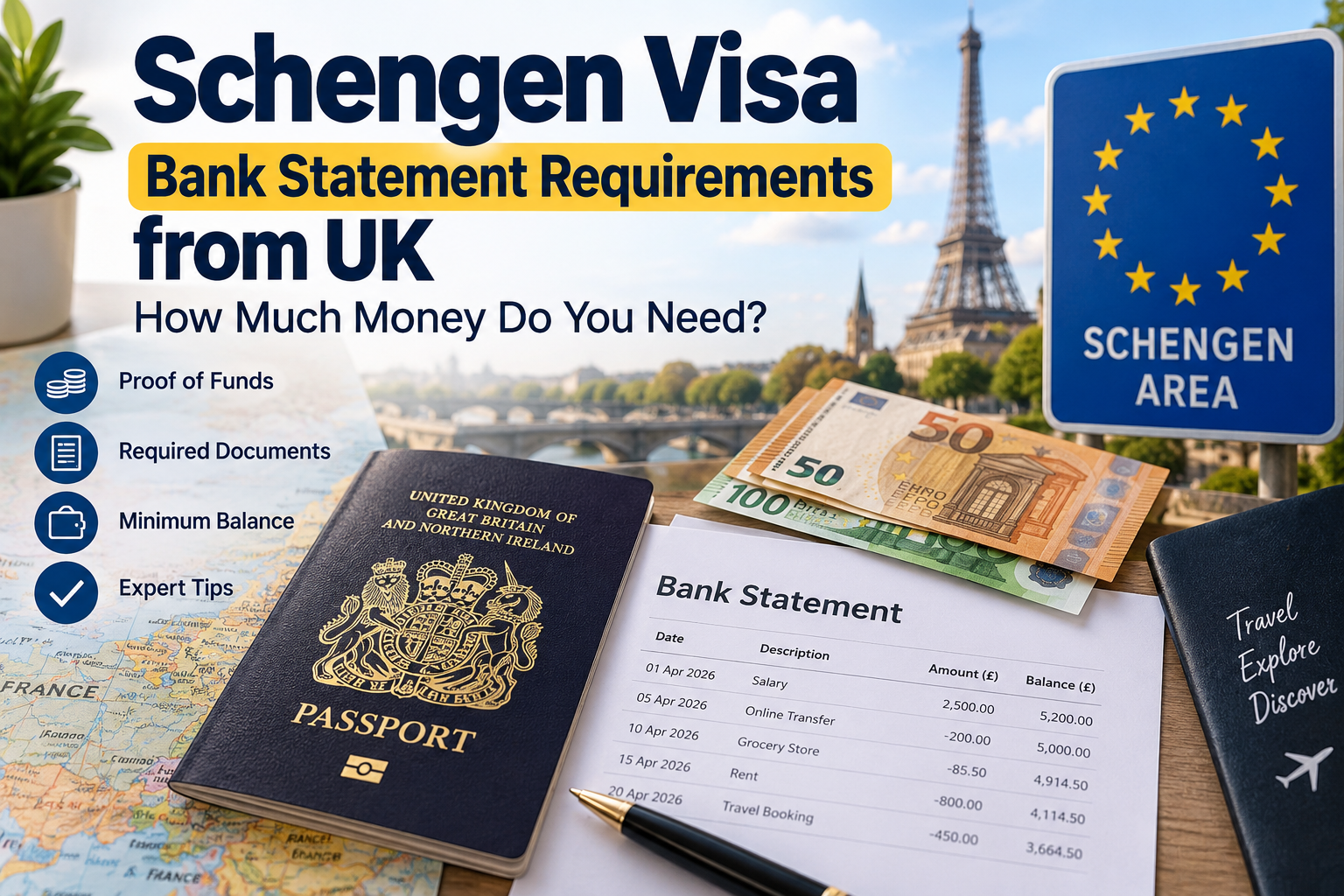
A bank statement is generally used to demonstrate that you have sufficient funds for your planned journey and that the money available to you is credible.
Under the EU Visa Code, applicants may need to provide evidence showing sufficient means of subsistence for their intended stay and for their return to their country of residence or onward travel. Applicants may also need to demonstrate their intention to leave the Schengen area before their visa expires.
For example, if you are planning a 10-day holiday in France, the visa authorities may consider whether your finances appear reasonable for a 10-day trip.
Your financial evidence should therefore make se
nse alongside the rest of your application, including your itinerary, hotel bookings, employment information and travel plans.
How Much Money Do You Need for a Schengen Visa?
There is no universal minimum bank balance for every Schengen visa application.
The amount you may need depends on the country you are visiting and the circumstances of your trip. Schengen countries use their own reference amounts when assessing whether applicants have sufficient means of subsistence.
Your required funds can therefore vary according to:
· The country or countries you are visiting
· The number of days you intend to stay
· Whether accommodation has already been paid for
· Whether flights have been booked or paid for
· Whether someone else is sponsoring your trip
· Your planned activities and travel arrangements
· Your personal financial circumstances
Rather than simply trying to maintain a particular balance, applicants should demonstrate that their available funds are sufficient and consistent with the proposed holiday.
For example, someone planning a short city break with prepaid accommodation may have different financial needs from someone planning several weeks of independent travel across multiple European countries.
Which Bank Statements Should You Provide?
The exact document requirements can vary according to the consulate or visa application centre handling your application.
Generally, applicants should provide recent bank statements covering the period requested by the relevant authority. The statements should clearly show the account holder's name, account details, transactions and available balance.
Your statements should ideally demonstrate normal financial activity rather than an unexplained large deposit immediately before your application.
If your salary is paid into the account, regular salary credits can help make the source of your funds easier to understand. Similarly, regular household expenses and other normal transactions can provide context for the balance shown.
Always follow the document checklist provided for your specific application rather than relying on a generic checklist found online.
Why Are Regular Transactions Important?
A healthy-looking balance is not necessarily enough by itself.
Visa authorities may consider the overall financial picture presented by your documents. A sudden large payment into your account shortly before submitting your application could raise questions if there is no explanation for where the money came from.
For example, suppose your account normally contains £2,000 but suddenly receives £8,000 shortly before your appointment. You should be prepared to explain the source of that money and provide appropriate evidence where necessary.
On the other hand, regular salary payments, consistent savings and ordinary spending patterns can make your financial circumstances easier to understand.
The objective should not be to make your bank account look artificially strong. It should be to present an accurate and well-supported picture of your finances.
What If You Have Recently Received a Large Amount of Money?
A large recent deposit does not automatically mean your Schengen visa will be refused.
However, unexplained deposits can make an application more difficult to assess.
If you have recently received money from a legitimate source, keep evidence explaining it. Depending on the circumstances, this could include:
· Salary or bonus documentation
· Evidence of a property sale
· A documented transfer from another personal account
· A loan agreement
· Sponsorship evidence
· Evidence of savings transferred between your own accounts
The important point is consistency. If your application says that you are paying for the holiday from personal savings, your financial documents should support that explanation.
Can You Use Savings for a Schengen Visa?
Yes, savings can form part of your financial evidence.
In fact, savings can be particularly useful when they are supported by a clear financial history. If you have gradually built up savings over time, your bank statements may demonstrate this.
However, applicants should not assume that simply having a large amount of money guarantees approval.
Schengen visa applications are assessed as a whole. Financial evidence is only one part of the application, alongside your travel purpose, accommodation, travel itinerary, passport, insurance and other supporting documents.
The EU Visa Code specifically refers to evidence concerning the purpose of the journey, accommodation, sufficient means of subsistence and the applicant's intention to leave before the visa expires.
What If Someone Else Is Paying for Your Trip?
You may still be able to apply if another person is paying for some or all of your trip.
For example, a parent, spouse, partner or another sponsor may cover your flights, accommodation or living expenses.
In this situation, the application should clearly explain who is paying and what expenses they will cover. Supporting evidence may be required to demonstrate the sponsor's financial ability and relationship with you.
Do not simply submit another person's bank statement without explaining why it is relevant to your application.
Your financial documents, sponsorship evidence and application form should tell the same story.
Which Other Financial Documents Can Support Your Application?
Bank statements are important, but they may not be the only financial documents relevant to your circumstances.
Depending on the application requirements, useful supporting evidence may include:
· Payslips
· Employment letters
· Proof of regular income
· Savings statements
· Pension evidence
· Business documents for self-employed applicants
· Sponsorship documents
· Evidence of prepaid accommodation
· Evidence of prepaid travel arrangements where appropriate
The purpose of these documents is to provide a coherent picture of your financial circumstances.
For example, an employed applicant could potentially demonstrate their financial position through bank statements alongside evidence of employment and regular income.
How Should Self-Employed Applicants Prove Their Finances?
Self-employed applicants may need to provide additional evidence because their income structure can be different from that of an employee.
Depending on the circumstances and the relevant application checklist, this could include business registration documents, business bank statements, tax documentation, invoices or other evidence demonstrating ongoing business activity.
The key consideration is credibility.
If you claim that you operate a successful business but your financial evidence does not reflect that activity, the application could become more difficult to assess.
Likewise, if your personal account receives regular transfers from your business, make sure the source of those funds can be explained.
What Other Documents Should Accompany Your Bank Statement?
A strong financial application should fit naturally with the rest of your travel documents.
You may need evidence relating to:
· A valid passport
· Completed visa application form
· Travel itinerary
· Accommodation
· Flights or travel arrangements
· Travel medical insurance
· Employment or study
· Financial circumstances
· Previous travel history where relevant
Travel medical insurance is also an important Schengen visa requirement. Under the EU Visa Code, qualifying insurance must cover the required territory and provide at least €30,000 of coverage for relevant medical expenses, including emergency medical treatment and repatriation.
Why Should Your Financial Evidence Match Your Itinerary?
One of the most common mistakes applicants make is preparing their financial documents separately from their travel plans.
Imagine that your application shows a modest budget but your itinerary includes expensive hotels, several internal flights and a long multi-country trip.
That could create an obvious inconsistency.
Instead, prepare a realistic itinerary and make sure your financial evidence supports it.
If your trip is inexpensive, explain it naturally through affordable accommodation, prepaid bookings or other genuine arrangements.
What Are the Common Bank Statement Mistakes?
Several avoidable mistakes can weaken an otherwise reasonable application.
Common problems include:
· Submitting incomplete statements
· Providing documents outside the requested period
· Showing unexplained large deposits
· Providing statements belonging to another person without explanation
· Using inconsistent information across documents
· Claiming income that cannot be supported
· Creating an unrealistic travel budget
· Relying entirely on a large last-minute deposit
· Ignoring the specific checklist of the relevant consulate
The safest approach is to provide genuine documents and explain unusual financial circumstances clearly.
How Can You Strengthen Your Schengen Visa Financial Evidence?
Start preparing your financial documents well before submitting the application.
Keep your banking activity genuine and organised. Avoid moving money between accounts simply to create an artificial balance.
If you have several accounts, determine which accounts are relevant and provide supporting documentation where necessary.
Most importantly, make sure your financial evidence matches your circumstances.
An applicant with regular employment, stable income, genuine savings and a realistic holiday budget can present a much clearer financial picture than someone who suddenly deposits a large amount of unexplained cash before applying.
What Should You Remember About Schengen Visa Bank Statements?
The most important thing to remember is that there is no magic bank balance that guarantees a Schengen visa.
The relevant authorities assess whether your financial circumstances are sufficient for the proposed journey and whether the information provided throughout your application is credible and consistent.
Prepare recent and genuine financial documents, explain unusual transactions, demonstrate where your funds come from and make sure your finances support your proposed itinerary.
If you are applying from the UK, always check the latest requirements of the specific Schengen country responsible for your application because document requirements and financial reference amounts can vary.
A well-prepared bank statement is not simply about showing money in your account. It is about demonstrating that your planned European trip is financially realistic and supported by credible evidence.